
Every few years, a business reaches a point where incremental improvement is no longer sufficient.
The problems compound faster than the fixes. Leadership is busy but the organisation is not moving. Revenue exists, but the structure underneath it does not match the ambition above it. And someone — usually the founder, usually after one quarter too many of missed targets — decides that what the business needs is a transformation.
So a programme is launched. Consultants are hired. Workstreams are opened. A steering committee meets monthly. Eighteen months later, the programme closes. A handover deck is presented. And within six months, the organisation has reverted to its previous operating reality — because nothing in that programme replaced the system. It only interrupted it.
Business transformation is not a project. It is a new operating system. Until leadership teams internalise this distinction — structurally, not just philosophically — the transformation budget will continue to fund the illusion of change rather than change itself.
The Misunderstanding That Makes Transformation Fail
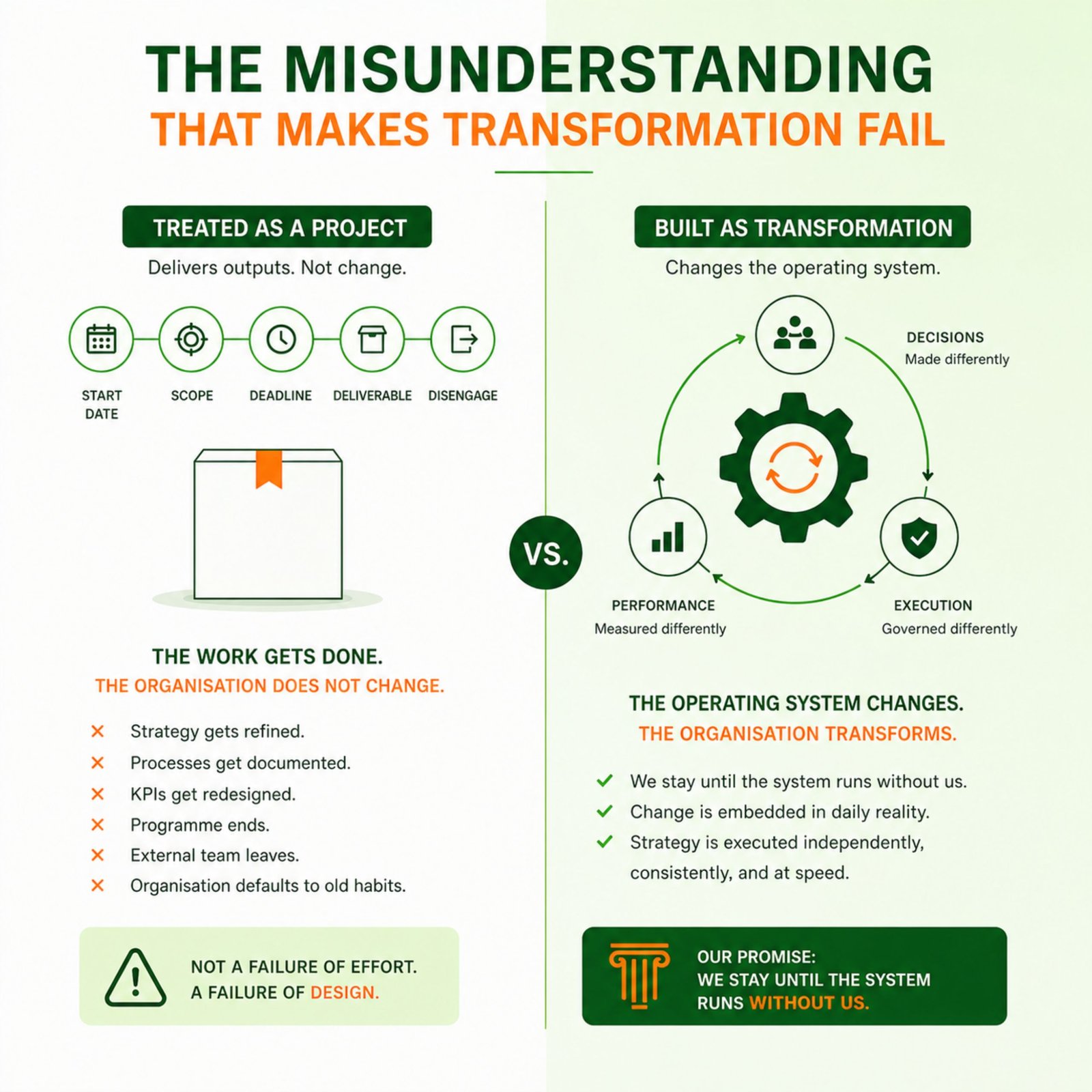
The most expensive mistake in business transformation is treating it as a project. Projects have a start date, a scope, a deadline, and a deliverable. Transformation has none of these things in the conventional sense. Furthermore, applying project logic to a transformation challenge produces a specific and predictable failure: the work gets done, but the organisation does not change. The strategy gets refined, the processes get documented, the KPIs get redesigned — and then the programme ends, the external team leaves, and the organisation defaults to the decision-making rhythms, accountability structures, and cultural behaviours that existed before the programme began.
This is not a failure of effort or intelligence. It is a failure of design. The programme was built to deliver an output — a new strategy, a new structure, a new set of processes. However, transformation requires something fundamentally different: the replacement of the system through which the organisation converts intention into action. That system — what Janus Intellect calls the Business Operating System — does not change because a consultant produces a new org chart or because the CEO declares a new strategic direction. It changes when the daily reality of how decisions are made, how performance is measured, and how execution is governed is structurally different from what it was before.
Most management consulting firms in India and globally are structured to deliver strategy and recommendations. They are not structured to embed operating system change — because embedding requires presence through execution, not just through design. The handover model — diagnose, recommend, present, disengage — is efficient for the consulting firm. It is structurally inadequate for the client.
Janus Intellect’s transformation model is built on a different premise: we stay until the operating system runs without us. The work is not complete when the strategy is designed. It is complete when the organisation executes the strategy independently, consistently, and at the speed the business demands.
What the Business Operating System Actually Is
The term “operating system” is used loosely in management literature. Janus Intellect uses it precisely. A business operating system is the interconnected set of structures, mechanisms, and rhythms through which a company converts strategy into execution and execution into measurable outcomes. It is not the strategy itself. It is not the organisational structure on paper. It is the lived architecture of how the business actually operates — how decisions are made, how performance is tracked, how accountability is assigned, and how the organisation corrects itself when execution drifts from intention.
Most businesses have an operating system. However, in founder-led and promoter-led businesses at the ₹100–500 crore scale, the operating system was almost never designed. It emerged organically from the founder’s working style, the early team’s habits, and the decisions that accumulated over years of growth. It worked at smaller scale because the founder’s presence and judgment compensated for its structural gaps. However, as the business grew, the informal operating system became a ceiling — not because the strategy was wrong, but because the system through which strategy was meant to become execution was inadequate for the complexity it was now required to manage.
The operating system of a business is invisible until it fails. By then, the failure has already compounded through months of missed execution, deteriorating margin, and a leadership team that is busy but not productive.
Sagar Chavan, Founder & CEO — Janus IntellectThe Five Layers of the Business Operating System
Janus Intellect structures the business operating system across five interconnected layers. Each layer must be designed, not inherited. Furthermore, each layer must be redesigned simultaneously during transformation — because a system is only as strong as its weakest layer, and partial redesign produces partial results that rarely hold beyond the programme horizon.
The first layer is decision architecture: who decides what, at what speed, with what information, and with what escalation path when decisions exceed individual authority. The second layer is performance infrastructure: what the business measures, how it tracks progress, what the consequence structure is for performance and underperformance, and whether the measurement system leads or lags the operational reality it is meant to reflect. The third layer is leadership accountability design: how roles, responsibilities, and authority are structured across the senior team — and critically, how this structure changes as the business moves from founder-led decision-making to distributed, team-led execution. The fourth layer is execution cadence: the governance rhythm of the organisation — the weekly, monthly, and quarterly operating reviews that keep strategy and execution in alignment. The fifth layer is commercial architecture: how the business goes to market, prices, manages contribution, and allocates growth investment — the layer most directly connected to EBITDA and the one most frequently underdesigned in scaling businesses.
A transformation programme that redesigns the strategy but leaves the operating system intact is not a transformation. It is a planning exercise with a larger budget. The operating system is the mechanism through which strategy either succeeds or fails. Design it deliberately, or inherit its failures by default.
The Five Transformation Failure Modes
In Janus Intellect’s experience across transformation engagements with founder-led and promoter-led businesses, transformation programmes fail in five specific and recurring ways. These failure modes are not mutually exclusive — in most failed programmes, three or four are simultaneously active. Furthermore, each failure mode is predictable at the programme design stage. The businesses that successfully transform are those that actively design against each failure mode from the beginning, rather than discovering them mid-programme when the cost of redesign is highest.
The Five Transformation Failure Modes™
Failure Mode One — Strategy Without Architecture
The most common transformation failure is producing a compelling new strategy and then asking the existing operating system to execute it. This is structurally contradictory. The existing operating system — its decision rights, its governance cadence, its performance metrics, its accountability structures — was designed for the business’s previous reality. It is optimised to execute the old strategy, not the new one. Consequently, when the new strategy meets the old system, the system absorbs, dilutes, and ultimately defeats the strategy — not through active resistance, but through the passive inertia of entrenched structure.
The correction is not to refine the strategy further. It is to design the operating architecture through which the new strategy will be executed before the strategy is finalised — because the architecture constrains what strategy is actually achievable. A strategy that requires distributed decision-making cannot succeed in an organisation where all decisions route through the founder. A strategy that requires margin discipline cannot succeed in an organisation where the performance system measures revenue, not contribution. Therefore, strategy and architecture must be designed together, not in sequence.
Failure Mode Two — Project Framing
When transformation is framed as a project, it inherits the structural liabilities of project management: a defined end date, a scope boundary, and a completion criterion. However, transformation has no natural end date — because the business operating system must continue to evolve as the business grows. Furthermore, project framing creates a specific and dangerous dynamic in the organisation: people comply with transformation requirements during the programme because compliance is visible and measured. However, compliance is not internalisation. When the programme ends and measurement stops, behaviour reverts — because the underlying system was never replaced, only temporarily overridden by programme pressure.
The most successful transformation programmes Janus Intellect has supported are those that were explicitly framed as system redesign initiatives rather than change projects. This framing shift changes the programme’s success criteria, its governance structure, and critically, its relationship to the organisation’s leadership team — because system redesign requires the leadership team to own the new operating system, not to receive it as a deliverable from an external team.
Failure Mode Three — Accountability Absence
New operating models consistently fail when accountability is diffused rather than assigned. A governance framework that lists six senior leaders as joint owners of an outcome has no effective owner — because joint ownership without clear decision rights and individual consequence structures produces collective drift rather than collective accountability. Moreover, accountability absence is particularly damaging during transformation, because transformation requires behaviour change that is uncomfortable and effortful. Without explicit accountability — with named owners, defined measures, and genuine consequences — the path of least resistance is always the old behaviour.
Janus Intellect’s accountability design framework assigns single ownership to every strategic and operational outcome in the new operating model. Furthermore, it builds consequence structures into the performance system — both positive consequences for transformation progress and explicit escalation paths for accountability failures. Additionally, it distinguishes between ownership and contribution: multiple leaders may contribute to an outcome, but only one owns it. This distinction, simple in theory, requires significant organisational negotiation in practice — particularly in founder-led businesses where informal authority has historically been more relevant than formal accountability.
Failure Mode Four — Measurement Mismatch
Most businesses entering transformation measure what they have always measured. Revenue, gross margin, headcount, and quarterly EBITDA — lagging indicators that reflect what the business did in the last period, not what the transformation is doing in the current one. Consequently, the leadership team cannot distinguish between transformation that is working slowly and transformation that is failing — until the financial results make the distinction unavoidable. By that point, the window for early correction has passed.
Transformation requires a leading indicator architecture: a set of metrics that track the health of the new operating system in real time, before those metrics appear in the financial statements. Decision turnaround time. Escalation frequency. KPI review completion rates. Execution cadence adherence. Commercial pipeline contribution quality. These are not soft metrics. They are the early signals of whether the new operating system is taking hold — and they are the indicators that allow the transformation to be steered during execution rather than evaluated after the fact.
Failure Mode Five — Leadership Misalignment
Leadership misalignment is the most consequential and the least visible of the five failure modes. It manifests when the senior team has publicly committed to transformation but privately holds divergent mental models of what transformation requires — particularly what it requires from each of them personally. The CEO believes transformation means a new strategy and a restructured organisation. The CFO believes it means cost discipline and tighter financial controls. The COO believes it means process standardisation. The head of sales believes it means a new GTM motion. None of these beliefs is wrong in isolation. However, without explicit alignment on the integrated operating system that ties them together, each leader pursues their version of transformation independently — and the programme fragments along functional lines.
Resolving leadership misalignment requires more than a strategy alignment session. It requires a structured process in which the senior team explicitly maps their individual mental models of the transformation, identifies the gaps and contradictions between them, and builds a shared understanding of the new operating system that is specific enough to govern daily behaviour — not abstract enough to mean different things to different people. Furthermore, this process must be facilitated by someone with the authority and analytical independence to name the contradictions that internal political dynamics make it difficult to surface.
What Transformation Actually Requires: The Janus Approach
Janus Intellect’s approach to business transformation is built around five principles, each of which directly addresses one of the five failure modes. These principles are not abstract — they govern the structure of every transformation engagement Janus Intellect undertakes, from initial diagnosis through operating system design to implementation and embedding.
Principle One — Design the Operating System Before Refining the Strategy
The first intervention in every Janus Intellect transformation engagement is an operating system audit — a structured diagnostic of the existing decision architecture, performance infrastructure, accountability design, execution cadence, and commercial architecture. This audit produces two outputs: a clear map of the structural constraints that are limiting the current business, and a set of design requirements for the new operating system that the transformation must produce. Only after these design requirements are defined does the strategy refinement work begin — because strategy must be designed within the constraints and capabilities of the operating system that will execute it.
This sequencing is counterintuitive. Most business consulting companies begin with strategy and move to operating model as a downstream consequence. Janus Intellect inverts this sequence because the evidence from transformation failures is clear: strategy without architecture is aspiration without infrastructure. The operating system is the lever. Everything else depends on it.
Principle Two — Frame Transformation as System Redesign, Not Change Management
Janus Intellect explicitly rejects the language of change management in transformation engagements. Change management implies that the task is to move people from resistance to acceptance of a new state. System redesign implies that the task is to build a new set of structures, mechanisms, and rhythms that make the new behaviour the natural outcome of the system — regardless of individual resistance or acceptance. Furthermore, this framing shift changes the leadership team’s role: in change management, leaders champion the change. In system redesign, leaders own the new system and are accountable for its performance.
Principle Three — Assign Single Accountability to Every Outcome
Every strategic and operational outcome in the new operating model is assigned to a single named owner. This owner is responsible not just for the outcome but for the system that produces it — the decisions, the resource allocation, the team alignment, and the escalation management that collectively determine whether the outcome is achieved. Moreover, the accountability assignment is explicit and public within the senior team — so that accountability gaps are visible before they produce execution failures, not after. Additionally, Janus Intellect builds accountability review into the governance cadence of the organisation — as a standing agenda item in the monthly leadership operating review, not as an annual performance conversation.
Principle Four — Build Leading Indicators Into the Performance System
Every transformation engagement includes the design of a leading indicator dashboard — a real-time visibility system that tracks the health of the new operating system before it appears in the financial results. The specific indicators vary by engagement, but they consistently cover decision quality metrics, execution cadence adherence, escalation patterns, pipeline contribution quality, and working capital behaviour. Furthermore, these indicators are reviewed at the same frequency as financial results — weekly for operational indicators, monthly for strategic ones — so that the transformation can be steered in real time rather than evaluated retrospectively.
Principle Five — Stay Through Embedding
Janus Intellect does not disengage when the operating system design is complete. We stay through the embedding phase — the period in which the new operating system must prove itself under real operating conditions, before its structures are sufficiently internalised to be self-sustaining. The embedding phase is where most transformation programmes fail, because it is the phase where external support is most commonly withdrawn precisely when it is most required. Consequently, Janus Intellect’s transformation engagements are structured with an explicit embedding phase — with defined milestones for operating system self-sufficiency and a clear criteria for when external support is no longer required.
Transformation in Practice: What the Evidence Shows
The theoretical case for operating system redesign as the foundation of transformation is straightforward. The practical case is more compelling — because it is grounded in what actually happens in businesses that approach transformation as system redesign versus those that approach it as a project or a strategy refresh.
A professional services firm with ₹120 crore in revenue was experiencing significant margin pressure despite an established market presence. The founding team had invested in strategy work twice in the preceding three years, producing refined positioning and new service offerings. However, each strategic refresh had failed to produce sustained margin improvement. The core problems were structural: weak process discipline across delivery teams, poor performance tracking and visibility, and leadership misalignment on goals — with each senior leader optimising for their function rather than for the integrated business outcome. Janus Intellect’s engagement began with an operating system audit rather than a strategy review, identifying the three structural causes of execution failure. The intervention covered process and KPI redesign, governance structure redesign with explicit accountability assignment, and the implementation of a rigorous execution cadence with weekly operating reviews at the senior team level.
A rapidly expanding multi-unit manufacturing group was facing critical scalability issues as it added production capacity across new locations. The problems were not strategic — the growth thesis was sound. The problems were operational and structural: fragmented decision-making processes slowing execution across units, inconsistent unit performance and standards, and a weak governance structure that left the group CEO with no real-time visibility into performance across the portfolio. Janus Intellect designed a comprehensive enterprise operating model — covering governance design, KPI standardisation across units, decision rights redesign, and a group-level execution cadence that produced weekly performance visibility at the CEO level without creating a centralised approval bottleneck.
An auto components manufacturer with ₹205 crore in revenue had grown volume by 18% but watched EBITDA margin erode from 14.5% to 11.2% — with ROCE declining to 13% in the same period. The founding team’s instinct was to pursue further volume growth to absorb fixed costs. Janus Intellect’s operating system audit revealed the structural cause: 22% of volume was delivered at sub-6% contribution margin, pricing reset lagged raw material cost increases by 14 months on average, and fixed costs had been sized for peak utilisation that was never reached. The transformation covered operating model redesign — contribution bridge analysis at the product and OEM level, strategic repricing with data-backed negotiation for the top three OEMs, and a phased cost normalisation programme. The shift was from volume-led growth to return-led discipline, embedded in a new operating system that made contribution visibility a standing feature of the monthly management review.
Volume without contribution is vanity. The shift to return-led discipline is not a strategic choice. It is an operating system choice — one that must be built into the measurement, incentive, and governance architecture of the business before it can hold.
CEO Takeaway — Auto Components Client, Janus Intellect EngagementThe CEO’s Role in Operating System Transformation
Business transformation cannot be delegated. This is perhaps the most important and most consistently resisted truth in transformation work. A CEO who appoints a transformation director, charters a steering committee, and reviews progress monthly has not led a transformation. They have sponsored a project. The distinction matters enormously — because the operating system of a business reflects the priorities and behaviours of its most senior leader. If the CEO does not personally model the new operating system — making decisions through its structures, reviewing performance through its metrics, and holding accountability through its mechanisms — the organisation will not adopt it. It will continue to operate through the informal system it knows: the one that runs through the CEO regardless of what the new org chart says.
This does not mean the CEO must be involved in every workstream. It means the CEO must be the primary owner of the new operating system — defining what it requires, committing to it publicly, and demonstrating it through their own behaviour before expecting the organisation to adopt it. Furthermore, the CEO’s commitment must be visible not just at the launch of transformation but through the embedding phase — because it is during embedding that resistance is highest and visible leadership is most consequential.
At Janus Intellect, every transformation engagement is structured as a CEO-level partnership. We work directly with the founder or CEO throughout — not through an organisational layer that filters the diagnosis and dilutes the intervention. This direct engagement model is not a preference. It is a requirement for the quality of transformation that produces durable operating system change. The CEO is the single most important variable in whether transformation succeeds or reverts — and we design our engagement model around that structural reality.
The operating system of a business is a mirror of its leadership. If the leader makes decisions informally, the organisation will. If the leader reviews performance annually, the organisation will. Transformation begins with the leader’s own operating system — and radiates outward from there.
The Transformation Decision Every Scaling Business Eventually Faces
There is a point in the growth trajectory of every founder-led business where the operating system that carried the business to its current scale becomes the primary constraint on its next phase of growth. The decision-making structure that worked at ₹50 crore does not work at ₹200 crore. The performance system that worked for a single-product, single-market business does not work for a multi-segment, multi-geography one. The governance cadence that worked when the founder could attend every meeting does not work when the organisation has grown beyond the founder’s personal bandwidth. This is not failure. It is the natural consequence of growth — and it is precisely the moment at which the transformation decision must be made.
The businesses that make this decision early — that begin operating system redesign before the structural constraints produce a crisis — have a significant advantage: they redesign under controlled conditions, with time to embed carefully, with leadership capacity available for transformation rather than consumed by firefighting. The businesses that defer the decision — that add strategy layers, hire more leaders, and open more channels in the hope that growth will outrun the structural problem — arrive at the same reckoning in a more compressed timeframe, with fewer resources and higher organisational fatigue.
At Janus Intellect, we work with founders and CEOs who have reached this decision point and are ready to build the operating system their next phase requires. Our role is not to deliver a transformation programme and disengage. Our role is to partner with the leadership team through the full arc of system redesign — from diagnosis through design through embedding — until the new operating system runs without us. That is what durable transformation looks like. And that is the only version of transformation worth investing in.
Business transformation is not the largest project your business will ever run. It is the last operating system your business will inherit by accident — and the first one it will build by design. The difference between those two outcomes is the distance between scale as a burden and scale as an advantage.
Frequently Asked Questions About Business Transformation
Business transformation in management consulting is the structured redesign of a company’s operating system — the interconnected set of decisions, structures, governance mechanisms, KPIs, and execution cadences through which the business actually operates. It is distinct from strategy projects, cost programmes, or restructuring exercises. Real transformation changes how the business functions permanently, not just what it plans to do next. Janus Intellect defines transformation as an operating system redesign — covering decision architecture, performance infrastructure, leadership accountability, and execution governance simultaneously.
Most transformation programmes fail because they are designed as projects — with a defined scope, a deadline, and a handover. Projects produce deliverables; transformation produces a new operating reality. When the programme ends, the old system reasserts itself because it was never replaced — only interrupted. Janus Intellect identifies five specific transformation failure modes: Strategy Without Architecture, Project Framing, Accountability Absence, Measurement Mismatch, and Leadership Misalignment. All five share a common cause: the programme addressed what the business should do without redesigning how the business actually operates.
A business operating system is the set of structures, mechanisms, and rhythms through which a company converts strategy into execution and execution into measurable outcomes. It covers five interconnected layers: decision architecture, performance infrastructure, leadership accountability design, execution cadence, and commercial architecture. Transformation is the deliberate redesign of this system — not the addition of new plans on top of the old one. In founder-led businesses, this system typically emerged informally over years of growth. Transformation makes it explicit, structured, and scalable.
The timeline depends on the depth of operating system redesign required and the pace at which the leadership team can embed change. In Janus Intellect’s experience with founder-led and promoter-led businesses in the ₹100–500 crore revenue band, first measurable structural outcomes — decision turnaround improvement, margin recovery, execution velocity — typically emerge within six to nine months. Embedding the new operating system fully, so it runs without external support, typically requires 18 to 24 months. Programmes that promise transformation in 90 days are delivering optimisation, not transformation.
Internal change initiatives fail at a higher rate than externally supported transformation for structural reasons. Internal teams lack the authority to challenge assumptions of senior leaders whose decisions created the problem. They also lack cross-industry benchmarks that calibrate what a well-designed operating system looks like. The best management consulting firms in India and globally bring structural objectivity, diagnostic rigour, and implementation continuity — staying through execution, not just through strategy delivery. Janus Intellect’s model is specifically built around this: we do not hand over a report. We stay until the new operating system is embedded and self-sustaining.
Is Your Business Ready for Operating System Transformation?
Janus Intellect works with CEOs and founding teams to design and embed the operating system their next phase of growth requires — from diagnosis through implementation to self-sustaining execution.
Request a Transformation Diagnostic