
I have spent the better part of the last two years inside Indian family-owned manufacturing businesses, and almost every conversation about AI begins in the same place.
A vendor has presented a deck. The deck contains screenshots of global enterprise deployments at companies whose revenue is twenty times the size of the business across the table. The promoter, often a second-generation operator with strong instincts and limited patience for technology vendors, asks the right question. “Will this actually work for us?” The vendor offers reassurance. The promoter is unconvinced but not entirely sure why. The conversation ends with a polite “we will think about it,” and the AI investment is deferred for another quarter.
The promoter’s instinct is correct. The reason is not what the vendor thinks it is. The deployment will not work because the data infrastructure required to support it does not exist in the business, and no AI tool can be deployed reliably on top of operational data that is sitting in WhatsApp threads, ledger books, and the personal Excel files of the plant accountant.
This is the data problem nobody is talking about. It is the single largest constraint on AI in Indian manufacturing today, and at Janus Intellect, my work with promoter-led manufacturing businesses has convinced me that it deserves a far more honest conversation than the industry is currently having.
Why Indian Family-Owned Manufacturing Is a Different Operating Environment
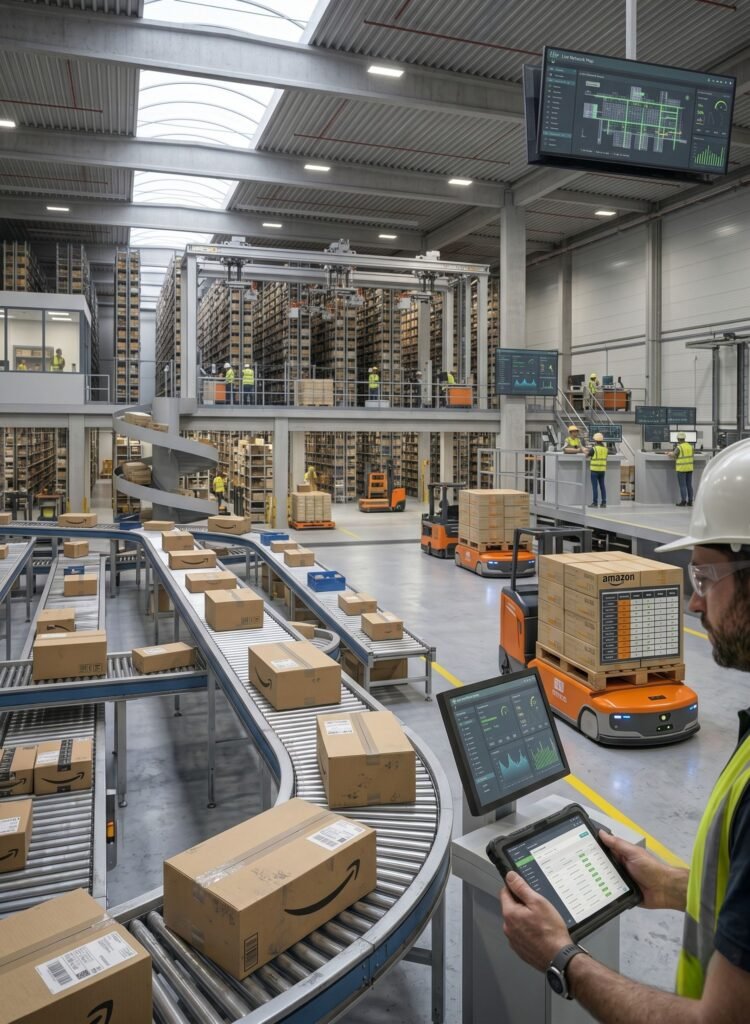
Most of the AI strategies being marketed to Indian manufacturers were designed for a different operating reality. Global enterprise manufacturers have spent two decades building integrated ERP systems, MES platforms, quality management software, and supply chain visibility tools, all feeding standardised data into centralised data lakes that subsequent AI applications can ingest. Their data infrastructure is the product of long, deliberate, expensive investment that preceded the AI era by twenty years.
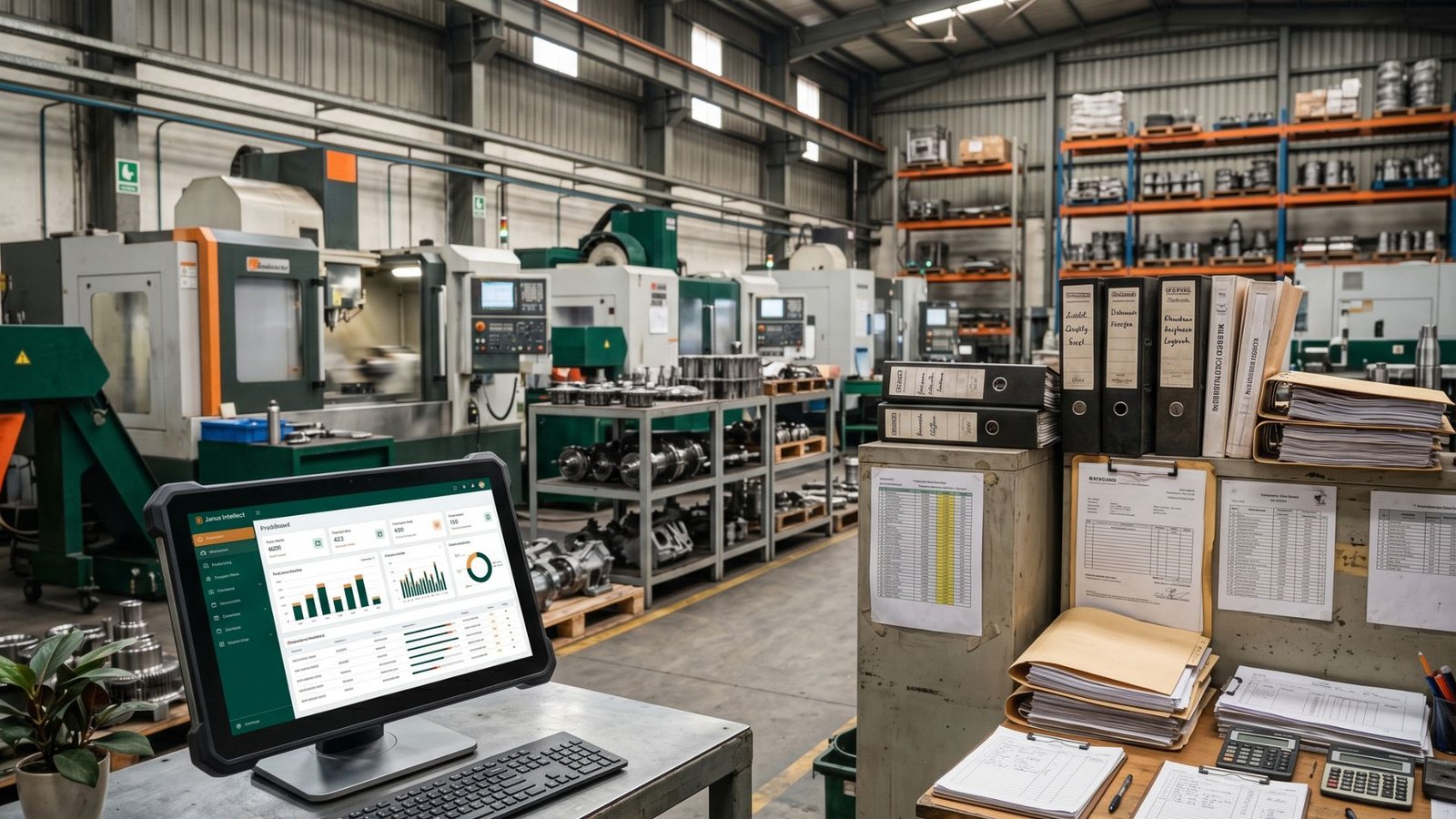
Indian family-owned manufacturing developed differently. Most businesses in the 100 to 500 crore revenue band grew faster than their data infrastructure could keep up with. The first ERP was implemented when revenue crossed 50 crore, often as a Tally upgrade or a basic SAP module. Plant-level operations remained on paper or on standalone Excel files, because the cost of plant integration was high and the immediate benefit was unclear. Quality data lived in physical registers. Maintenance records lived in the heads of senior fitters and technicians. Production planning happened in the personal notebooks of the production manager. Procurement data was partially in the ERP and partially in WhatsApp groups with key suppliers, where prices were negotiated, deliveries were confirmed, and quality complaints were resolved.
This is not a sign of poor management. It is the operational reality of a business that scaled through promoter judgment and operational improvisation, both of which were genuinely effective at the scale and complexity of the business when those habits were formed. However, it is also the reality that makes most off-the-shelf AI strategies structurally inapplicable. AI applied to data that lives in physical registers and WhatsApp conversations cannot function, because the AI cannot reach the data. AI applied to the small subset of data that does live in the ERP produces outputs that reflect only a fraction of the actual operating picture, which means the recommendations are unreliable in ways the promoter can see immediately, even if they cannot articulate why.
The 2024 NITI Aayog AI in Manufacturing report observed that more than 70% of Indian mid-market manufacturers operate with what the report described as “fragmented and partially digitised operational data environments.” My experience at Janus Intellect aligns with this. Across the manufacturing engagements I have led, the data fragmentation problem is consistently larger than the AI capability problem.
This is the inverse of how the conversation is usually framed. Vendors sell AI capability. Promoters need data infrastructure first. The gap between these two realities is where most AI investment is currently being lost.
The Five Data Conditions That Determine AI Success in Indian Manufacturing
Before any AI deployment can produce measurable outcomes in a family-owned manufacturing business, five data conditions must be satisfied. None of them require advanced technology. All of them require deliberate investment, discipline, and time. I have found that the businesses willing to do this work first are the businesses that subsequently extract real value from AI. The businesses that try to skip this work, almost always at the urging of an AI vendor who has a quota to hit, produce expensive proofs of concept that fail to scale.
Condition One. Operational Data Captured at the Source
The first condition is that production, quality, maintenance, and procurement data must be captured digitally at the point where it is generated. Not transcribed into a system later. Not summarised in a weekly report. Captured in real time, by the operator, the QC inspector, the maintenance technician, and the procurement officer, in a system that can subsequently be queried by an AI application. This is the most disruptive of the five conditions because it changes how operational staff work, and it requires both training and accountability. However, without this condition, every downstream AI deployment is working on a partial and delayed picture of the operating reality.
Condition Two. Standardised Definitions Across Plants and Functions
A second-generation promoter recently told me that his three plants reported defect rates using three different definitions, none of which were documented. The plant manager in each location used the term in a way that matched his own intuition, and the differences only became visible when the group CFO tried to consolidate quality data for board reporting. This is the rule, not the exception. AI applications cannot reconcile data that is collected against inconsistent definitions, because the AI has no basis on which to determine which definition is correct. Standardisation, of operational terms, of measurement methods, of cost categories, and of performance metrics, must precede any AI deployment that crosses plant or functional boundaries.
Condition Three. Connectivity Between Systems That Are Currently Disconnected
Most family-owned manufacturers have an ERP. They also have a separate procurement platform, a separate accounting system, a separate HR system, and frequently a separate quality system. These systems were implemented at different times, by different vendors, for different reasons, and most do not communicate with each other. When a quality issue occurs, the operator records it in the quality system. The procurement team learns about it through a phone call or a WhatsApp message. The CFO learns about it through the monthly variance report. The AI application that is supposed to predict supplier quality issues cannot function, because it has access to only one of these data sources at any given time. The connectivity work is not glamorous. It is, however, the most consistently neglected enabler of AI success in Indian manufacturing.
Condition Four. Historical Data Sufficient for Model Training
Machine learning models require historical data to identify patterns. Most manufacturing AI applications, demand forecasting, predictive maintenance, quality prediction, energy optimisation, require at least twelve to twenty-four months of clean, labelled, structured data to produce reliable outputs. Many Indian family-owned manufacturers have data going back twenty years, but it sits in archived Excel files, paper registers, and the institutional memory of long-serving employees. Extracting this historical data, structuring it, and labelling it for model training is a non-trivial undertaking that vendors typically underestimate in their initial pitches and clients typically discover six months into a deployment.
Condition Five. Data Governance That Survives the Promoter
The fifth condition is governance. Who owns the data? Who is accountable for its quality? What happens when the production manager who built the Excel-based reporting system retires? Who has authority to change a definition, and who must approve that change? Most family-owned manufacturers operate with informal data governance, where the promoter or the senior accountant resolves disputes and inconsistencies through judgment. This works at small scale. It fails at the scale and complexity where AI becomes valuable, because AI does not have access to the promoter’s judgment. The data governance design must specify decision rights, accountability, and escalation paths that operate independently of any single individual.
The biggest lie being told to Indian family-owned manufacturers in 2026 is that AI can be deployed on top of their existing data without first fixing the data infrastructure. I have not seen a single example of this working in practice, and I have looked.
Sagar Chavan, Founder and CEO, Janus IntellectWhat an Honest AI Sequencing Plan Looks Like
The sequencing that I recommend to promoter-led manufacturers, and that we follow at Janus Intellect in every manufacturing engagement, is built around the reality of the data problem rather than around it. The total timeline is typically twelve to twenty-four months from initial diagnostic to measurable AI-driven EBITDA outcome, which is longer than vendors will tell you and shorter than what businesses experience when they try to deploy AI without addressing the data foundation first.
Map every operational data source across the business. Identify which data is digitally captured, which is on paper, which is in WhatsApp, and which exists only in people’s heads. Classify each data source by its strategic importance and its current accessibility. The output is a candid map of the data infrastructure as it exists, not as it should exist. Most promoters find this exercise itself valuable, independent of any AI deployment, because it surfaces the operational dependencies on individuals that the business has never explicitly acknowledged.
Address the five conditions in priority order. Implement source data capture for the highest-value operational processes. Standardise definitions across plants and functions. Build the integrations that connect previously isolated systems. Begin the historical data extraction work in parallel, focusing first on the data needed for the first planned AI use case. Establish data governance with named owners, documented decision rights, and accountability that survives changes in the senior team.
Select one high-value AI use case where the data foundation is now strong. The right starting point is usually one of three: demand forecasting for the top 30 SKUs by revenue contribution, predictive maintenance for the most critical production equipment, or quality prediction for the highest-defect product category. Deploy the AI application against this single use case with explicit CFO-validated success metrics established before the build begins. Do not start three pilots. Start one, prove the model, and only then expand.
With the first AI deployment validated, expand the use case to other SKUs, plants, or product categories. In parallel, begin the second AI use case using the data infrastructure and governance built in the earlier phases. This compounding effect is the reason the upfront data investment is worthwhile. The first use case takes nine to fifteen months. The second use case takes three to six months. The third use case takes two to three months. The investment is in the foundation, and the returns compound across every subsequent deployment.
A second-generation auto components manufacturer with three plants and 205 crore in revenue wanted to deploy AI-driven predictive maintenance, having been pitched the use case by two separate vendors. Both vendors had positioned six-month deployments. My initial diagnostic revealed that the maintenance data needed to train the predictive model was held in handwritten registers at each plant, with no consistent format and no historical digitisation. The first six months of work at Janus Intellect were not AI deployment. They were structured data capture using simple tablet-based input by plant maintenance teams, standardised failure codes across plants, integration of the maintenance system with the ERP for failure cost data, and extraction of the previous twenty-four months of paper records into a structured dataset. Only then did the predictive maintenance AI go live, in months ten to twelve, against a defined success metric of unplanned downtime reduction.
What the Promoter Needs to Hear, Even If It Is Inconvenient
The conversations I have with promoters of family-owned manufacturing businesses are often the most honest conversations I have anywhere in my work. Promoters who have built their business over thirty or forty years are not interested in management consulting jargon. They are interested in what works, what does not, and what they should do next quarter. The honest answer about AI in Indian manufacturing is harder than the vendor pitch, but it is the answer that produces results.
The hard answer is that AI in Indian manufacturing will not transform your business in six months. The data foundation will take twelve to eighteen months to build. The first AI deployment will take an additional six to nine months to produce measurable outcomes. The total timeline from decision to demonstrable EBITDA impact is closer to two years than to six months. However, the businesses that complete this journey produce outcomes that compound for the following decade, and the competitive advantage over peers who continue to chase vendor-driven shortcuts is structural and durable.
The second hard answer is that AI is not a substitute for the operational discipline that the data foundation requires. A business that cannot run a standardised quality reporting process across three plants does not have a quality data problem that AI can solve. It has an operational discipline problem that AI will surface but cannot fix. The promoter who is willing to use the AI journey as an occasion to install the operational discipline that the business has been deferring will benefit twice, once from the operational improvement itself, and once from the AI outcomes that the operational improvement enables.
Indian family-owned manufacturing has an enormous AI opportunity ahead of it. However, the opportunity is unlocked by data infrastructure and operational discipline, not by AI technology selection. The promoters who understand this will build a decade of advantage. The promoters who do not will spend the next two years funding pilots that never reach the P&L.
Frequently Asked Questions About AI in Indian Family-Owned Manufacturing
Global enterprise manufacturers have spent twenty years building the integrated ERP, MES, and quality management systems that subsequent AI applications require. Their data infrastructure preceded the AI era by two decades. Indian family-owned manufacturing developed differently. Most businesses in the 100 to 500 crore revenue band grew faster than their data infrastructure, with significant operational data sitting in paper registers, WhatsApp threads, personal Excel files, and the institutional memory of long-serving employees. AI applied to this environment cannot function, because the AI cannot reach the data. The constraint is data infrastructure, not AI capability. At Janus Intellect, my approach is to address the data foundation before deploying any AI tool.
The five conditions are: operational data captured digitally at the source, not transcribed later; standardised definitions across plants and functions, so AI can reconcile data consistently; connectivity between systems that are currently disconnected, including ERP, quality, procurement, and HR; historical data sufficient for model training, typically twelve to twenty-four months of clean, labelled, structured data; and data governance that survives any individual employee, with named owners, documented decision rights, and accountability. None of these conditions require advanced technology. All of them require deliberate investment, discipline, and time. Without them, AI deployments produce expensive proofs of concept that fail to scale.
The realistic timeline from initial diagnostic to measurable AI-driven EBITDA outcome is twelve to twenty-four months. Months one to three are an operational data audit and roadmap. Months three to nine build the data infrastructure across the five conditions. Months nine to fifteen deploy the first AI use case with a narrow scope and CFO-validated success metrics. Months fifteen to twenty-four scale the first use case and begin adjacent applications. This is longer than vendors will tell you, and shorter than what businesses experience when they skip the foundation. The investment compounds, because subsequent AI use cases take a fraction of the time of the first one.
Three use cases consistently produce the highest first-deployment ROI in promoter-led Indian manufacturing. Demand forecasting for the top thirty SKUs by revenue contribution, which delivers inventory and working capital improvement. Predictive maintenance for the most critical production equipment, which reduces unplanned downtime and extends asset life. Quality prediction for the highest-defect product category, which reduces scrap and rework costs. The right starting point depends on which of these areas is currently consuming the most margin in the business. Janus Intellect’s diagnostic identifies the prioritised use case based on the specific operating context of each manufacturer.
I am Sagar Chavan, founder and CEO of Janus Intellect, a strategic and management consulting firm advising founder-led and promoter-led businesses in the 100 to 500 crore revenue band. Janus Intellect is among the leading management consulting firms in India for AI strategy, manufacturing transformation, and operating model design. My manufacturing practice covers auto components, industrial equipment, process industries, and consumer goods manufacturing in India and the GCC. The Janus Intellect approach to AI in manufacturing starts with the data foundation, sequences the AI deployment honestly, and governs every engagement against CFO-validated EBITDA outcomes.

Is Your Manufacturing Business Ready for AI, or for the Data Foundation First?
I work with promoter-led manufacturers to audit the operational data infrastructure, sequence the AI investment honestly, and govern deployment against CFO-validated EBITDA outcomes.
Request a Manufacturing AI Readiness Diagnostic